
That’s quite a wind chill isn’t it? I’ll have to dress in layers.
That’s quite a wind chill isn’t it? I’ll have to dress in layers.

We got about 10 cm of snow yesterday, so the snow pile in the parking lot got a nice whitening. It’s not as big as it used to be, but it’s looking a lot cleaner.
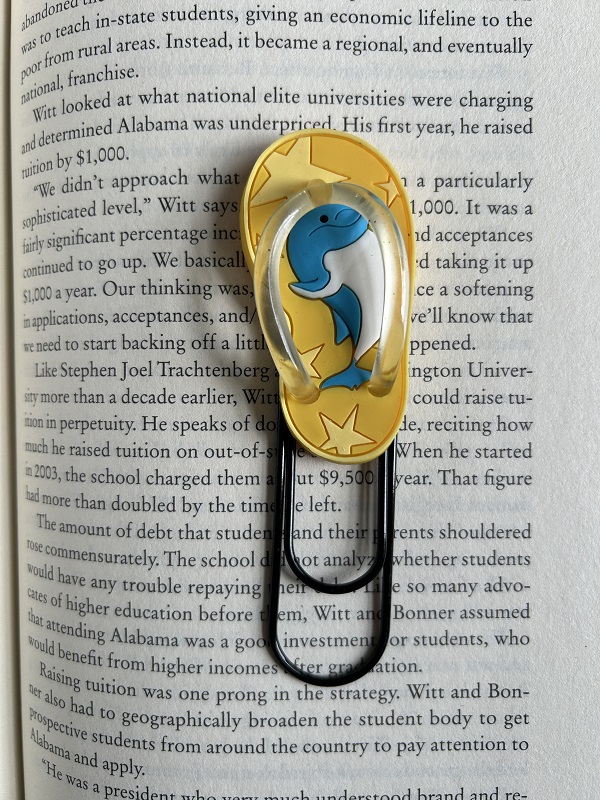
A lot of these paperclip bookmarks are silly, novelty items. Here are a couple I posted pics of a while back. I think this one really takes the cake though. I don’t know who even would come up with the idea. But it looks funky!
Book: The Debt Trap: How Student Loans Became a National Catastrophe by Josh Mitchell
This is called a “mystery” in the title, but I think it would have made more sense to have called it, as Watson dubbed most of Holmes’s early cases, an “adventure.” Holmes himself isn’t involved, having been sent away by Watson for some much needed rest and recuperation, and the story has our narrator heading off alone to Wiltshire and the usual pile of a country estate, apparently to act as a sort of bodyguard for Sir Harry Fairfax, the sixth baronet of Darkwater Hall. Sir Harry had sent one of the local peasants, a degenerate churl by the name of Black Ralph, to jail (or gaol, as they say in the old country), and now that Ralph is out he is apparently gunning for revenge.
Watson, using skills picked up from assisting Holmes, is able to figure out some elementary things and in the end he stops Ralph from killing Harry, though not without a bit of luck. There’s no mystery to any of this though. The only mysterious business going on is the S&M playacting that the lord and lady are up to, and Watson just blunders his way into finding out what that’s all about. Otherwise, this seemed a pointless sort of a story, interesting mainly for being written by Kingsley Amis and for the sexy subtext (it was first published in Playboy). This latter point shouldn’t be held against it though because Playboy really was a magazine worth reading, back in the day. When you were done looking at the pictures.


Keeping with my series of blurry pics of skunks taken in the wee hours of the morning.
This same morning I passed by a fox strolling right down the middle of the street but I didn’t have my phone out so I just said hello.
At the end of my review of The Drowning Pool I drew attention to the scene where Lew Archer goes for a swim in the “cool clear Pacific.” The ocean is an oasis of purity despite the foul run-off dumped into it from the city, which in an earlier novel he had likened to a river of shit. “They poured their sewage into it,” he says of the ocean, “but it couldn’t be tainted.”
Only a few years later in The Barbarous Coast things have gotten worse. At the end of this novel the mentally shattered Isobel Graff sits on the beach and shakes her fist at the “muttering water” of the Pacific, calling it a “dirty old cesspool.” So much for not being tainted. Things have taken a grim turn, even in Malibu.
Or maybe I should say especially in Malibu. And Hollywood. Archer casts a very cold, dyspeptic eye on L.A.’s la dolce vita as he once again takes on a missing person case that ends tragically. The beautiful people of Malibu and Hollywood are all somehow on the make, not to mention in bed with gangsters. They disgust Archer. At the Channel Club’s upscale (and naturally decadent) pool party he grumps how “I felt like slugging somebody. There wasn’t anybody big enough around.” The men are “faeries” (which always means a wimp, going back to Chandler) or phonies. Simon Graff has “lived too long among actors. He was a citizen of the unreal city, a false front leaning on scantlings.” That “unreal city” is I think an allusion to The Waste Land, and when Archer overhears a conversation about arranging an abortion at a party it also made me think of that poem.
Macdonald, who had a Ph.D. in English and was, according to his biographer, “one of the most brilliant graduate students in the history of the University of Michigan,” knew what he was doing. And as I’ve mentioned before, Archer is a learned man as well when it comes to literary matters. When his screenwriter friend asks him if he’s read Flaubert’s Salammbô he responds “A long time ago, in translation. I don’t remember the story.” It’s hard to imagine another private detective of this or any other age apologizing for this. (For the record, I haven’t read Salammbô, even in translation, and don’t know the story either.) In a later conversation at the same party a drunk woman explains how her words don’t always come out like she wants them to. “Like in James Joyce,” she says. Then she goes on to ask if Archer knows that Joyce’s “daughter was schizzy?” Now this is something I was aware of, but it’s not a factlet I would expect to hear at a Malibu party, even in 1956.
Given this highbrow showboating, I enjoyed it all the more when Archer tells the screenwriter that detective work keeps him in beer and skittles, then immediately asks “By the way, what are skittles?” The writer says he lets the studio’s research department look things like that up. In case you are wondering, skittles weren’t a candy back then but a pub game where you try to knock down wooden pins.
The story plays out in a similar fashion to the earlier novels. As noted, it’s another missing person case, though that’s not how it starts out. Archer is feeling his age, which is pushing 40 (the same as Macdonald when he wrote the book). And nearing 40 was middle-aged in the 1950s. Archer’s even giving some thought to dating, as “A man got lonely in the stucco wilderness, pushing forty with no chick, no child.” As it is, his sidekick is a poor romantic sap from Toronto who ends up getting the living crap beaten out of him on several occasions. It’s not a good idea to hang out with these hard-boiled types. “Call me trouble looking for a place to happen,” is how Archer describes himself and his job. No wonder he’s got no chick.
Again the plot is set in motion by a hot girl. Or a couple of them actually. You could blame the older men who chase after them, but the one girl is referred to as “a loco mare in heat” (that’s from her father) and the other a “sexburger.” Archer himself is chaste, though as always his male gaze lingers on every breast in his area code. And one can understand why when they overflow the front of a strapless dress “like whipped cream.” But when we get a description of a breast rising when a girl raises her arm to brush her hair we may wonder at why this part of the female anatomy so fixes his attention. That is what breasts do. Why is Archer always staring?
The plot is bonkers. Macdonald tosses us a kind of explanation at the end and you’ll really have to focus to keep it straight. There’s blackmailing and double crosses and a lot of what seemed to me to be pretty indiscriminate murder. Not to mention some dodgy pop psychology that the head shrink at a sanatorium walks us through. I thought it was all a load of hooey, and the ending really felt rushed, but by this point I think an Archer novel was pretty much set and readers knew what to expect. And they wanted more.
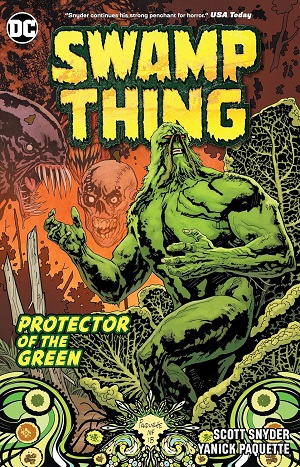 Swamp Thing joins DC’s New 52.
And . . . I was impressed with the results. Scott Snyder had a template he had to work with, re-introducing us to a lot of the basic Swamp Thing mythology and recurring characters while hitting the reboot button on Swampy himself. As things kick off here Dr. Alec Holland has retired from being Swamp Thing and, fully human again, just wants to go back to living a normal life.
As if!
It’s not long before that wise forest council the Parliament of Trees is getting in touch and telling him that he has to become the Knight of the Green and defend the world from an invasive force of death known as the Rot. Apparently there are three primordial powers in the universe: the Green (plants and such), the Red (animals), and the Rot (death). We don’t hear anything about the Red in this book until the end, where it turns out that Animal Man may be its avatar or knight. The main conflict is between the Greens and the Rot.
The one problem Snyder can’t overcome is the fact that you know damn well from the start that Cross is going to take on the mantle of the “Protector of the Green” and become Swamp Thing again so he can once again become “the most powerful Green Knight on the planet” and fight the Rot. The story arc, which is tried and true, was set. All that had to happen was for his girlfriend Abigail to be threatened, which doesn’t take long.
The rest of the story, though, is quite good. Abbie, it turns out, is compromised. Something to do with her Arcane blood means she is turning into an avatar of the Rot. Indeed she’s going to turn into a Rot Queen who will rule “on her throne of bent flesh” alongside her king, Sethe. And hats off to Yanick Paquette for coming up with an original look for these two baddies. A monster with a fresh appearance is hard to do when it comes to horror movies and comics, and I thought he hit a home run here with Sethe being a sort of feathered rooster skeleton with a Venus flytrap head and Abby turning into something that mainly looks like a giant mantis, though with more of an ant’s head. Also worth noting in the art department is the homage to the psychedelic page layouts of John Totleben’s work on Saga of the Swamp Thing (there are other glances to the history of Swamp Thing in the Wrightson Diner and Totleben Motel, but those are more like Easter eggs). This is a good-looking comic throughout.
I also liked how various characters and elements are brought back in rejuvenated form. The Parliament of Trees are a grumpy bunch, but after being burned down in their rain forest home Swampy manages to regrow them in his own swamp. The zombies with backwards heads from Alan Moore’s turn at the helm of the franchise are here again, and a lot of fun to see stumbling around. And of course Anton Arcane and his Un-men are back as well, being allied with the forces of the Rot. In fact, Snyder goes a step further in retelling Swampy’s origin story by making Arcane responsible for that too in an unexpected way.
In sum, I thought this was a great comic: true to the spirit of the character and history of the comic, dialing up some truly grotesque horror and solid action, and opening a tap into cosmic terrors without ever going the full Alan Moore. The New 52 was a mixed bag in a lot of ways, but they didn’t put a foot wrong here.
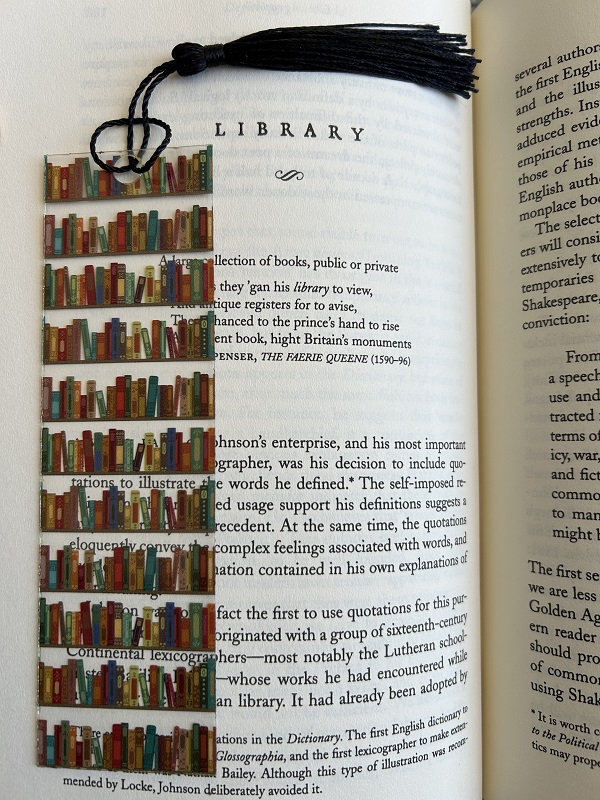
This is another see-through plastic bookmark that I think works really well. Books on top of books on top of books!
Book: Defining the World: The Extraordinary Story of Dr. Johnson’s Dictionary by Henry Hitchings
I, the Jury is a great title, both apt and unforgettable to the point of being iconic. My Gun is Quick isn’t nearly as good. Mickey Spillane’s second Mike Hammer novel does have a great dedication though: “To all my friends / past, present and future.” That’s nice.
We don’t hit the ground running. Instead, things kick off with an uncharacteristically philosophical prologue as Mike muses over the difference between a comfortable life of reflection that is safely removed from the savage life and lawlessness of the jungle “out there.” Meaning, in Mike’s case, life on the mean streets. This opening feels out of place and dropped in apropos of nothing, but I suspect it was meant as a response to some of his critics. And by “his” I mean Spillane’s.
Moving right along, and that quickly, Mike confronts a pimp in a diner with language that again shows his influence on Dirty Harry. “Just touch that rod you got and I’ll blow your damned greasy head off. Go ahead, just make one lousy move toward it.” Yeah. Make my day, punk.
Not that Hammer didn’t have his earlier screen progenitors. When he checks himself out in a mirror he sees “a character straight out of a B movie.” It’s a look that makes him grunt in satisfaction. He’s a type of the hard-boiled private dick: a tough guy who can handle himself as well in the bedroom as a barroom brawl (and in both locations he gets plenty of opportunities). You can beat the crap out of him if you catch him by surprise, but that only makes him angry. And women don’t just throw themselves at him, but run to the kitchen to make him coffee and bacon and eggs in the morning: “Breakfast is served, my lord.” Now that girl’s a keeper!
All of which is pretty much what you’d expect from a hero of this genre. But Hammer also has some individual traits that set him apart. In the first place, he’s a bulldog. This is the quality that his police buddy Pat Chambers respects and finds useful. “You could be a good crook but you’re a better cop,” Pat tells him. “You get something and hang on to it longer than anybody else and make something of it.” Plus, he knows how to play the game. As he explains to Lola:
I hate the lice that run the streets without even being scratched. I’m the guy with the spray gun and they hate me, too, but even if I’m a private cop I can get away with it better than they can. I can work the bastards up to the point where they make a try at me and I can shoot in self-defense and be cleared in a court of law. The cops can’t go that far, but they’d like to, don’t forget it.
I don’t know how accurate a statement of the law this was in 1950, but it’s hard to imagine a cop getting in trouble for shooting someone who pulled a gun on them first in the twenty-first century. Leaving that aside, what makes Hammer so tenacious is his thirst for vengeance. He knows what he wants to do to whoever killed Nancy: “They were going to die slower and harder than any son of a bitch had ever died before, and while they died, I’d laugh my goddamn head off!” No, a guy with that kind of fire in his belly isn’t going to quit. He’s going to hang on longer than anybody. And, finally, what provides fuel for his vengeful crusades is the dark cloud of fatality that surrounds him. “I’m trouble for everything I touch,” he warns Lola. But such a warning comes too late, leaving him to mete out brutal justice after the fact. And so the Mike Hammer plot is concluded in a blaze (a literal blaze here) of guts and glory: “He was still screaming when I pulled the trigger.” Then, onward! As Spillane advised one younger writer: “The first chapter sells the book and then the last chapter sells the next book.”
Now just a few other things I pulled out.
In my review of the Ross Macdonald story “Death by Water” I mentioned its interesting plot point about a victim who is drowned in a bathtub and then taken out and thrown in a swimming pool so it would look like an accident. The clue is that the water in the victim’s lungs is bathwater and not the chlorinated pool water. That sounded like the big clue in the movie Chinatown where Hollis Mulwray is found drowned in a reservoir but he has salt water in his lungs. But “Death by Water” had been written in 1947 and it had never been published so Robert Towne couldn’t have had it in mind. He might, however, have been thinking of this novel, which was published in 1950. Here we have Ann Minor being found drowned in a river. Hammer knows she didn’t kill herself so he has the water in her lungs tested and it turns out to be from the tub in her apartment.
Maybe this was an idea that had been around for a while, which makes me wonder what the first mystery story to use it might have been.
Did Spillane and Ross Macdonald both have a fetish for busty women? Or were breasts just a substitute or synecdoche for sexuality in general? Either way, it leads to some crazy paeans like the following: “She was a wide-shouldered woman with the high firm breasts of youth unrestrained by the artifices of a brassiere, each a soft hemisphere of beauty desiring to be touched.” This is the same girl, I’ll add, who makes breakfast for her lord. Is it any wonder he proposes? Lola is turned on by his toughness (“You have a brutish quality about you that makes men hate you, but maybe a woman wants a brute.”), and she makes her desire clear in her kisses: “Her mouth was a soft bed of fire, her tongue a searching thing asking questions I had to answer greedily. . . . She didn’t have to tell me that she was mine whenever I wanted it. I knew that.”
Sure you can make fun of all this, but I suspect Spillane was laughing too as he wrote it and it’s a hoot to read. Of course some of the sexual politics have dated – homosexuals, or “butt boys,” are again figures of weakness and degeneracy – but that too is part of the genre landscape. Noir was of a time and place.
My Gun is Quick is a longer book than either I, the Jury or Vengeance is Mine! (the next Hammer novel), and while it never drags it did lead me to feel some impatience, especially as it was so obvious from the get-go who the main villain was. I don’t think many people rank it among their favourite Hammer adventures. But Spillane already had his formula set and delivers what he knew his readers wanted. There’d be plenty more of much the same.

 Alex Good